- For Admissions Contact
- +91 9731292555
- +91 9880143028

An Autonomous Institution under VTU from 2024-25
AICTE Approved, Accredited by NBA(CSE,ISE,ECE,ME,CV) NAAC with A+ grade, QS I-Gauge Gold rated
P.B. No. 20, B.B. Road,
Chickballapur- 562101, Karnataka.
NATIONAL CADET CORPS
The National Cadet Corps (NCC) is the youth wing of the Indian Armed Forces. It is a Tri-Service Organisation encompassing the Army, the Navy, and the Air Force, open to school and college students across India on a voluntary basis. Established under the NCC Act of 1948, the NCC serves as a platform to develop the leadership potential of India’s youth and prepare them for a life of national service.
Headquartered in New Delhi and administered under the Ministry of Defence, the NCC is headed by the Director General (DG). With over 15 lakh cadets enrolled nationwide, it is one of the largest uniformed youth organisations in the world. NCC cadets receive training in discipline, drill, adventure, social service, and national integration — emerging as responsible citizens ready to contribute to any walk of life, including the Armed Forces.
The NCC provides the youth of the country opportunities to develop qualities of character, courage, comradeship, discipline, leadership, secular outlook, spirit of adventure and sportsmanship, besides the ideals of selfless service, to make them useful citizens. The Corps also creates a human resource of organised, trained and motivated youth to provide leadership in all walks of life, always available for the service of the nation.
The motto of the NCC is “Unity and Discipline” (Hindi: एकता और अनुशासन). It was formally adopted during the 12th Central Advisory Committee (CAC) meeting held on 12 October 1980. The motto encapsulates the twin pillars on which the Corps stands — Unity among the diverse peoples of India, and Discipline that forges strength of character in every cadet.
The word “Unity” reflects the NCC’s commitment to national integration — bringing together cadets from every religion, region, language, and background under one flag. “Discipline” reflects the rigorous training, punctuality, respect for authority, and self-regulation that every NCC cadet imbibes through their training years.
“We, the cadets of the National Cadet Corps, do solemnly pledge that we shall always uphold the unity of India. We shall be worthy citizens of our great nation and willingly discharge our duties and obligations. We shall be disciplined and responsible members of our community. We shall, to the best of our ability, serve our nation, and be ever ready to dedicate ourselves to its cause.”
The NCC has two primary aims that guide all its training and activities:
Primary Aim
To develop qualities of Character, Courage, Comradeship, Discipline, Leadership, Secular Outlook, Spirit of Adventure and Sportsmanship, besides the ideals of Selfless Service among the youth, to make them useful citizens.
Secondary Aim
To create a human resource of organised, trained and motivated youth, to provide leadership in all walks of life including the Armed Forces, and always be available for the service of the nation.
The Eight Core Values NCC Builds
The National Cadet Corps is a Tri-Service organisation with a well-defined hierarchical structure from the national level down to individual school/college units.
Command Hierarchy
| Level | Role / Position | Remarks |
|---|---|---|
| National | Director General (DG NCC), New Delhi | Ministry of Defence — overall command |
| State/UT | Directorate-Karnataka & Goa Directorate, Bengaluru | Oversees all Groups & Battalions in the state |
| Group HQ | Group Headquarters-Group B, Bangalore | Commands multiple NCC Battalions |
| Battalion | NCC Battalion-5 KAR Bn NCC, Bangalore | Commands affiliated college/school units |
| Unit Level | SJCIT NCC Unit | The individual training unit |
Tri-Service Wings
► Army Wing: The Army Wing has a Senior Division (SD) for college students and a Junior Division (JD) for school students. Training focuses on military drill, weapon training, map reading, field craft, first aid, and physical fitness. Cadets in the Army Wing compete for the Thal Sainik Camp (TSC) at the national level and are considered for Republic Day Camp selections.
► Naval Wing: The Naval Wing (Senior Wing for colleges, Junior Wing for schools) provides training in seamanship, boat pulling, sailing, naval drill, and maritime subjects. Cadets may participate in the Nau Sainik Camp (NSC) and sailing competitions at the national level.
► Air Wing: The Air Wing provides exposure to aviation, gliding, microlight flying, aeromodelling, and aerospace concepts. Cadets can aspire to attend the Vayu Sainik Camp (VSC) at the national level and gain flying experience, making this an ideal wing for those interested in aviation careers.
The NCC Certificate examinations are nationally recognised credentials awarded by the Directorate General of NCC. They reflect a cadet’s commitment, training, and discipline over their tenure. The ‘B’ Certificate and ‘C’ Certificate are the two highest credentials available to Senior Division/Wing cadets and carry significant weightage in defence service entries and government employment.
NCC ‘B’ Certificate Examination
| Year of Study | Details |
|---|---|
| Year of Study | End of 2nd year of Senior Division/Senior Wing NCC training |
| Attendance | Minimum 75% of total training periods in Year 1 and Year 2 of SD/SW training |
| Camp Requirement | Must have attended at least one Annual Training Camp (ATC), NIC, COC, RDC, or attachment with Regular Army/Navy/Air Force |
| Break in Training | Break in training tenure must not exceed 18 months at any one time |
| Examination Period | Conducted in February – March each year |
| Format | Written examination (theory) + Practical assessment |
Syllabus — ‘B’ Certificate (Core Subjects):
NCC ‘C’ Certificate Examination
| Criteria | Details |
|---|---|
| Year of Study | 3rd year of Senior Division/Senior Wing NCC training |
| Prerequisite | Cadet must already possess the NCC ‘B’ Certificate |
| Attendance | Minimum 75% of training periods in the 3rd year syllabus |
| Camp Requirement | Must have attended at least ATC, RDC/TSC/VSC/NIC/CATC |
| Examination Period | Conducted in February – March each year |
| Format | Higher-level written examination + comprehensive practical assessment |
Syllabus — ‘C’ Certificate (All ‘B’ subjects PLUS):
Career Benefits of NCC Certificates
Camps are the centrepiece of NCC training, where cadets put theory into practice, forge lifelong friendships, and develop leadership under realistic conditions. Each camp typically accommodates 400–600 cadets.
State-Level Camps
Annual Training Camp (ATC)
The Annual Training Camp (ATC) is a mandatory state-level camp held under the aegis of the respective NCC Directorate. It typically spans 10 days and is organised at the battalion or group level. The ATC is a key prerequisite for appearing in the NCC B and C Certificate examinations.
Training at ATC covers intensive drill, weapon training, physical training, map reading exercises, first aid practicals, cultural programmes, and community service. Cadets are graded on their performance, turnout, and participation. The ATC experience forms the backbone of every cadet’s NCC journey.
Combined Annual Training Camp (CATC)
The Combined Annual Training Camp (CATC) brings together cadets from multiple units or colleges under a single, larger camp, organised at the Group or Directorate level. It promotes healthy inter-unit competition, broader camaraderie, and exposure to cadets from diverse backgrounds.
CATCs feature inter-unit competitions in drill, sports, cultural activities, and subject knowledge tests. Performance in CATC competitions influences the selection of cadets for national-level camps.
National-Level Camps
Republic Day Camp (RDC)
📍 Location/Period: New Delhi, 01 Jan – 29 Jan
The most prestigious NCC camp of the year. Approximately 2,070 selected cadets from all states and Union Territories gather at Delhi Cantonment. The highlight is the NCC contingent marching at Kartavya Path (formerly Rajpath) on Republic Day — 26th January. Being selected for the RDC is considered one of the highest honours for any NCC cadet. The camp also features the PM Rally, DG’s Flag Competition, cultural programmes, and an All India Cadet Exchange.
Thal Sainik Camp (TSC)
📍 Location/Period: HQ DGCC, Delhi Cantonment
The national-level Army Wing competition for Senior Division cadets. Two TSCs are conducted annually — one for SD/JD Boys and one for SW/JW Girls — with 680 boy and 680 girl cadets participating in each. Events test cadets on military skills including obstacle courses, weapon training, drill competitions, and physical fitness.
Vayu Sainik Camp (VSC)
📍 Location/Period: National Level
The national camp for Air Wing cadets, attended by approximately 600 cadets from all Directorates. The VSC features inter-directorate competitions in aviation knowledge, ground subjects, drill, and sports. Selected cadets may also get opportunities for flying sorties and gliding experience.
Nau Sainik Camp (NSC)
📍 Location/Period: National Level
The national camp for Naval Wing cadets, with approximately 560 participants from across the country. Key events include boat pulling regatta, sailing competitions, naval drill, and maritime skill assessments. The NSC fosters the spirit of the sea among India’s young cadets.
National Integration Camp (NIC)
📍 Location/Period: Pan-India
NICs are conducted to foster understanding and appreciation of India’s rich and diverse cultural heritage. 37 NICs are held annually at various locations. Six Special NICs are held at the strategic extremities of the country: Leh/Srinagar (J&K), Dimapur (North East), Peddapuram (Andhra Pradesh), Badabagh/Jaisalmer (Rajasthan), Lakshadweep, and Port Blair (Andaman & Nicobar). Cadets experience different states’ cultures, traditions, and food, returning with a deeper sense of national unity.
Adventure Camps
📍 Location/Period: Various Locations
NCC organises trekking expeditions to the Himalayas and Western Ghats, rock climbing, river rafting, paragliding, cycling expeditions, mountaineering courses, and para-jumping courses. These camps challenge cadets physically and mentally, building resilience, self-confidence, and the spirit of adventure.
Youth Exchange Programme (YEP)
📍 Location/Period: International
Selected NCC cadets are deputed to friendly foreign countries as ambassadors of India’s youth. Countries visited include Russia, UK, Singapore, Bhutan, Vietnam, Kazakhstan, and others. Foreign cadet delegations also visit India, fostering international goodwill and cross-cultural understanding.
Army/Navy/Air Attachment Camps
📍 Location/Period: Military Establishments
Cadets get the opportunity to be attached to regular Army, Naval, or Air Force units and establishments for a short period, providing direct exposure to professional military life, equipment, and culture. These camps are highly coveted and help cadets decide on Armed Forces careers.
| Full Name of Institution | Sri Jagadguru Chandrashekaranatha Swamiji Institute of Technology (SJCIT) |
| Location | B.B. Road, Chickballapur, Karnataka – 562101 |
| NCC Wing | Army Wing — Senior Division (SD) |
| Battalion | 5 Karnataka Battalion (5 KAR Bn) NCC |
| Group | Group B, Bangalore |
| Directorate | Karnataka & Goa Directorate, Bengaluru |
| Year of Establishment | 2018 |
| Certificates Offered | NCC ‘B’ Certificate and NCC ‘C’ Certificate |
| Annual Training Camp | ATC / CATC under 5 KAR Bn |
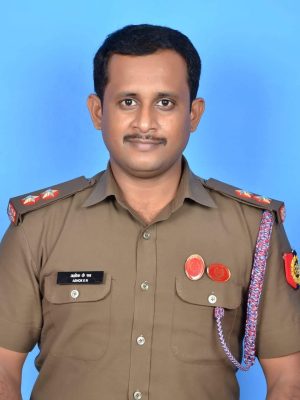
| Rank | Lieutenant (Lt.) — Army Wing |
| Full Name | Ashok K N |
| Designation | Associate NCC Officer (ANO) |
| Unit | NCC SJCIT, 5 KAR Bn NCC |
| Group | Group B, Bangalore |
| Role at Institution | Assistant Professor, Department of CSD, SJCIT, Chickballapur |
| Contact Email | [email protected] |
| Associated Since | 22nd July 2022 (CTO) after Training @ Officers Training Academy, Kamptee, Nagpur with Lieutenant rank on 09th September 2023. |
Associate NCC Officer (ANO) | SJCIT NCC Unit | 5 KAR BN NCC
Lt. Ashok K N serves as the Associate NCC Officer (ANO) of the NCC unit at Sri Jagadguru Chandrashekaranatha Swamiji Institute of Technology (SJCIT), Chickballapur, under the 5 Karnataka Battalion NCC (NCC No. NCC/06110499). A dedicated faculty member at the institution, he has been the cornerstone of the SJCIT NCC unit since 22nd July 2022. Under his inspired leadership, the unit has trained hundreds of cadets in the values of discipline, national service, and leadership. Lt. Ashok K N has guided every batch of cadets through Annual Training Camps, B and C Certificate examinations, and national-level competitions — producing cadets who proudly represent Karnataka on the national stage.
His hands-on approach to training, his accessibility to cadets at all times, and his personal commitment to the NCC mission have made him a mentor cadets look up to for guidance both within and beyond the parade ground. He exemplifies the highest ideals of an ANO — a leader who serves not for rank but for the love of the nation and its youth. Lt. Ashok K N’s contribution goes beyond training; he has built a culture of excellence, camaraderie, and selfless service that defines the SJCIT NCC unit’s identity, with a vision to make it one of the most distinguished units under 5 KAR Bn.
On 4th February 2025, Lt. Ashok K N was honoured with the prestigious Commendation by the Deputy Director General, Karnataka & Goa Directorate, NCC — one of the highest recognitions conferred upon NCC officers for outstanding service. The commendation, awarded by Air Commodore SB Arunkumar, DDG NCC, Karnataka & Goa, at Bengaluru, reads:
“I am pleased to learn that while serving in the NCC Organisation you have rendered service of a very high order, thus enhancing the image of the National Cadet Corps and winning laurels for NCC Directorate Karnataka & Goa. I commend you for your exceptional devotion to duty and the example you have set for others in the NCC Organisation.”
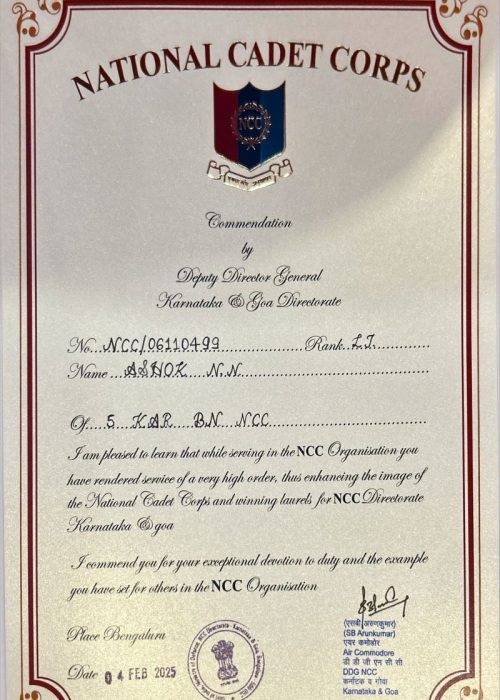
This recognition is a reflection of Lt. Ashok K N’s relentless dedication across 5 KAR BN NCC — his tireless effort in training cadets, organising camps, and upholding the standards of the NCC at the institutional and directorate level. In his acknowledgement of this honour, Lt. Ashok K N expressed heartfelt gratitude to the Revered Swamijis of Sri Mutt for their blessings; to the SJCIT Management, Principal Dr. G T Raju Sir, and Administrative Officer Shri Rangaswamy G R Sir for their unwavering institutional support; to his cadets, whose dedication remains his greatest inspiration; and to Col. Lunik Basu Roy Sir, whose mentorship and trust he credits as instrumental in this achievement.
The DDG Commendation Card is not merely a personal milestone — it stands as a collective honour for the entire SJCIT NCC family and a proud moment for 5 KAR BN NCC.
Key Responsibilities
Liaising with the battalion CO and Group HQ for all official matters

A premier institute imparting technical education since 1986. The college is situated on Bangalore – Hyderabad National Highway-NH7, 45 kms from Bangalore city about, 20 kms from Kempe Gowda International Airport (Bangalore International Airport) and about 5 kms from Muddenahalli, the birth place of Sir M. Visvesvaraya. The famous hill resort Nandi hill is about 15 kms from the college.